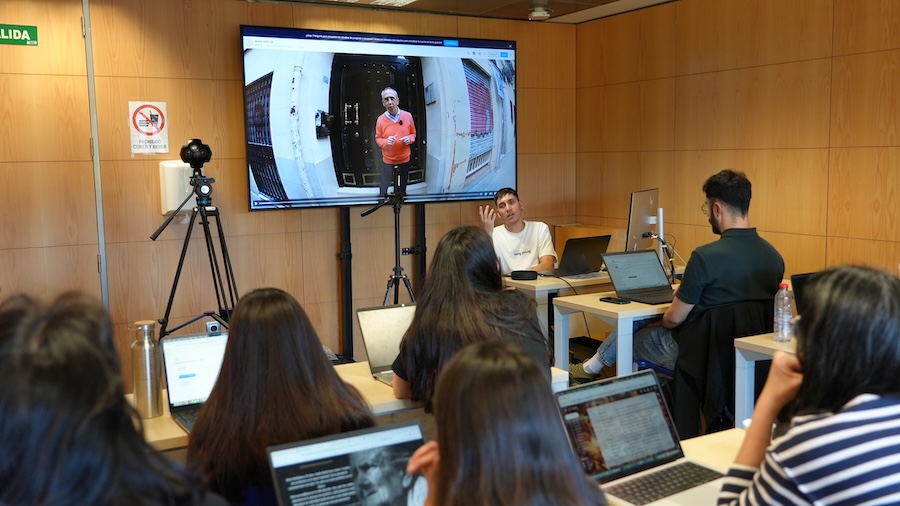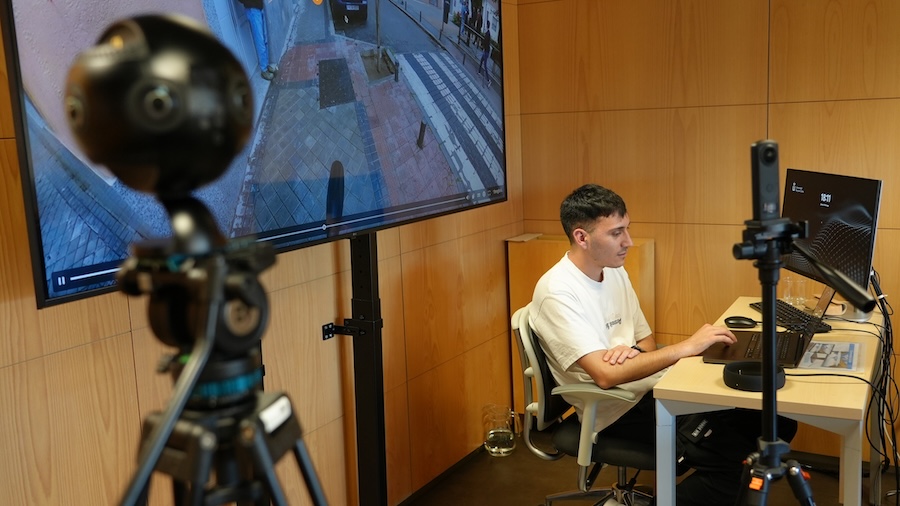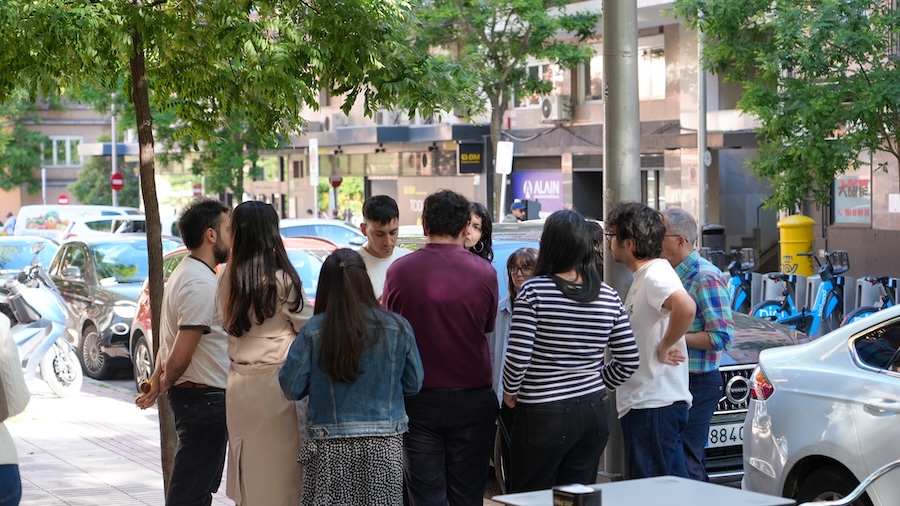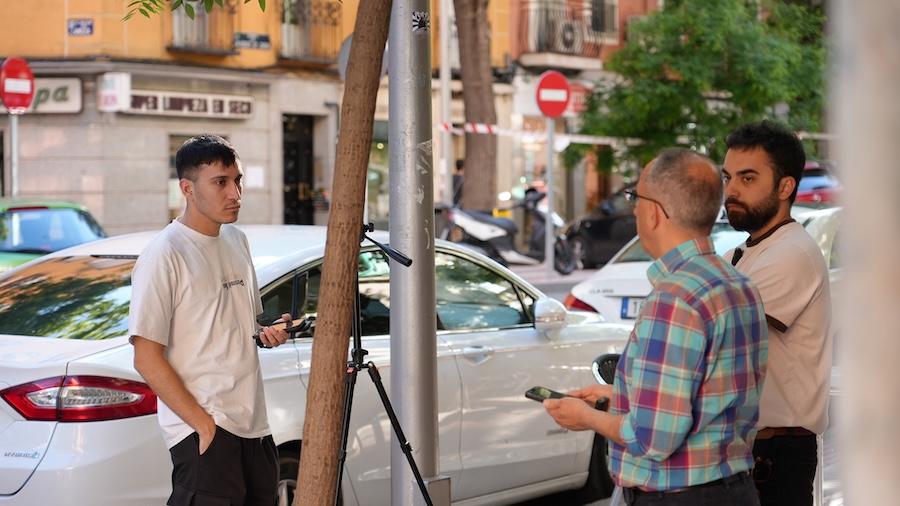
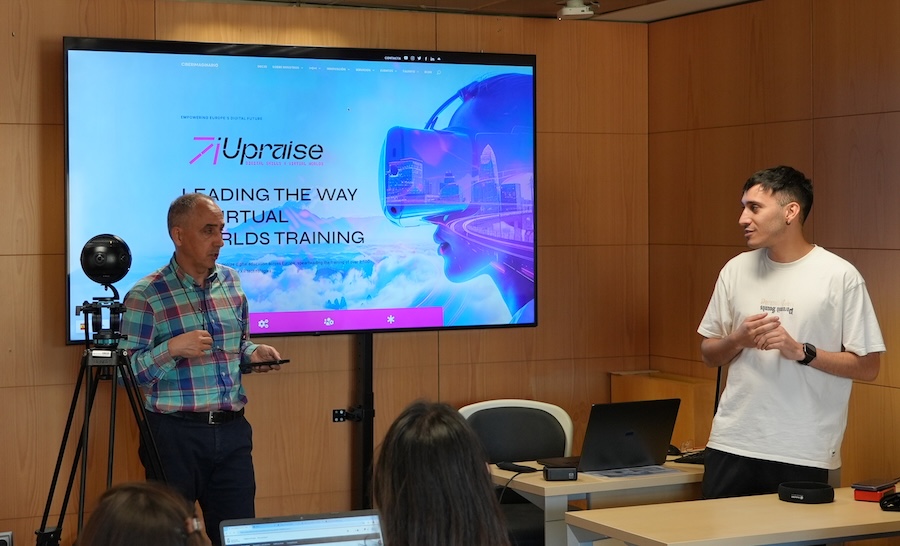
What does it take to train a journalist to work in immersive, geolocated environments? At the XR COM LAB and the Ciberimaginario Research Group of Universidad Rey Juan Carlos, a recent eight-hour training activity offered a concrete answer: by combining data journalism methods with 360° production, spatial storytelling and interactive publishing tools, all framed within the European project UPRAISE (Virtual Worlds Innovation Masters).
The activity was co-designed and delivered with the Master’s Degree in Investigative Journalism, New Narratives, Data, Fact-Checking, Transparency and Artificial Intelligence at URJC, and led by Professor Manuel Gértrudix Barrio with the participation of Alberto Sánchez and Alberto Rodríguez.
From the data set to the inhabited street
The exercise was structured around the published feature «Mapa de un atropello» (madridapie.ciberimaginario.cloud), a data-driven investigation on pedestrian road safety in Madrid that documents 304,061 people involved, 10,891 incidents and 205 fatalities. Rather than treating these figures as the endpoint of the investigation, students were challenged to translate the data into a situated, embodied experience: a day in the life of María, an 82-year-old pedestrian walking 200 metres to her local bakery.
This translation, from the data set to the inhabited street, is precisely the kind of competency that UPRAISE aims to develop in its Education and Creativity vertical.
Building advanced immersive competencies, step by step
- The eight-hour training was designed as a complete production cycle, with measurable learning outcomes at each stage:
- Reading the city as data. Students learned to interrogate open municipal data sets, contrast official sources (Madrid City Council, DGT, WHO) and turn statistical patterns into geographically situated narratives.
- Geospatial storytelling. Using ArcGIS StoryMaps, participants built cartographic narratives published under the institutional URJC account, developing competencies in spatial narrative design and data visualisation for public-interest journalism.
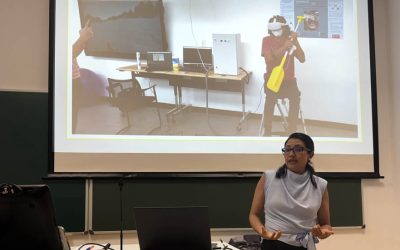
- Immersive capture in the field. With professional Ricoh Theta Z1 and Insta360 Pro cameras, students learned the foundations of 360° production: scene design for omnidirectional capture, hidden-operator workflows, external-audio synchronisation, and ethical considerations in public space.
- Interactive immersive editing. Using ThingLink, each team built a point-of-view scene with decision hotspots, data hotspots and audio hotspots, embedded into a Shorthand journalistic container designed with the Ciberimaginario editorial template.
Competencies aligned with the Education and Creativity vertical
This training operationalises several of the advanced digital skills that UPRAISE seeks to deliver across European higher education institutions:
- creating immersive educational and journalistic content using XR tools
- producing 360° video content with a pedagogical and civic purpose
- designing narrative structures for immersive experiences that balance emotion and information
- integrating XR learning and storytelling objects into web-based publishing environments
- assessing accessibility, ethics and learning outcomes of immersive content addressed to vulnerable audiences
These competencies are not abstract. They are demonstrated, evidenced and made public through the pieces produced by the students.
A model for immersive journalism education in Europe
By connecting a national-level journalistic investigation with an immersive production workflow, this UPRAISE-framed activity offers a replicable model for how higher education can train journalists, communicators and content creators to work in virtual worlds with rigour and public purpose.
The pieces produced are now part of the open educational resources of the Master, demonstrating how UPRAISE’s ambition to build a sustainable EU community of leaders in advanced digital skills can take a very concrete form: a student, a 360° camera, and a story about a city that needs to think a little harder about who walks through it.